
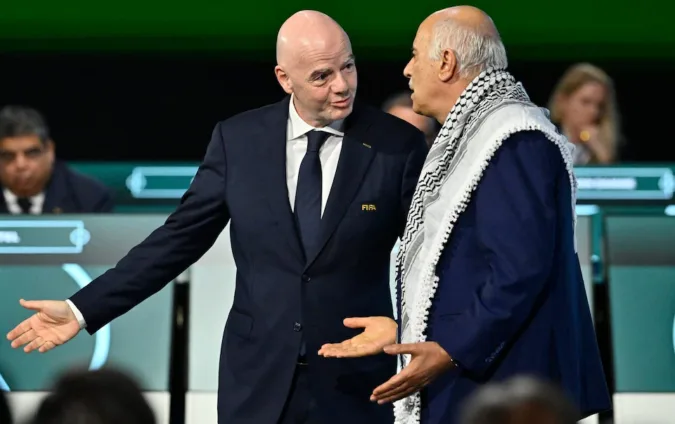

Tensions in global football politics were once again laid bare as the president of the Palestine Football Association declined to shake hands with the vice-president of the Israel Football Association during a high-profile session at the FIFA Congress.
The incident, which unfolded in full view of delegates and officials from across the football world, underscored the deep political divisions that continue to spill into the sport. As representatives exchanged customary greetings ahead of proceedings, the Palestinian FA president visibly withheld a handshake from the Israeli FA vice-president, signaling a clear protest tied to the ongoing Israeli-Palestinian conflict.
Observers at the Congress described the moment as tense but not entirely unexpected, given the longstanding friction between the two football associations. The Palestinian FA has, on multiple occasions, raised concerns within FIFA over issues including movement restrictions on players, infrastructure challenges, and broader political conditions affecting football activities in Palestinian territories.
While FIFA has consistently positioned itself as a neutral body committed to unity through sport, such incidents highlight the difficulty of separating football from geopolitics. The Congress, typically a platform for governance discussions, development strategies, and global football policies, briefly became a stage for symbolic political expression.
Delegates present noted that although the situation did not escalate beyond the refusal, it drew significant attention and sparked quiet discussions among member associations. Some viewed the act as a form of protest, while others expressed concern over the increasing politicization of football’s global मंच.
FIFA has yet to issue an official statement specifically addressing the incident. However, the organization has historically urged member associations to promote respect, dialogue, and the spirit of fair play, both on and off the pitch.
The episode adds to a series of moments where international sporting events have mirrored broader global tensions, raising questions about the role of sports diplomacy and whether football can truly remain insulated from political realities.
