
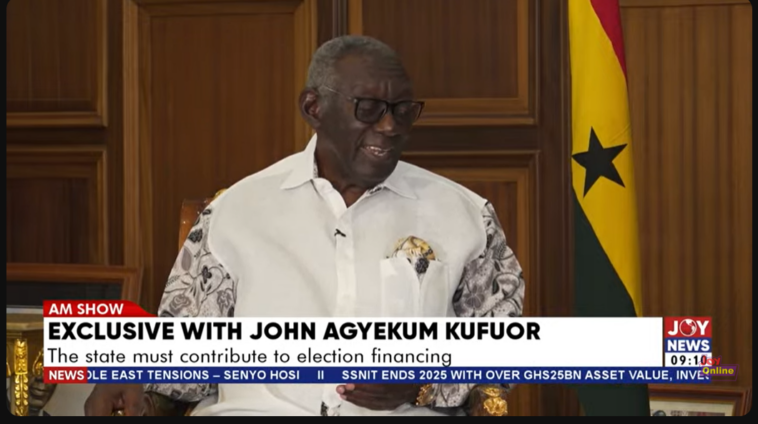

Former President John Agyekum Kufuor has called for a stronger separation of powers among the three arms of government, stressing that Ghana’s democracy will be better protected if Parliament is given greater authority over the national budget.
According to the former leader, the current governance structure gives excessive control to the executive arm of government, particularly in matters relating to public finances. He believes empowering Parliament to exercise deeper scrutiny and control over the national budget will strengthen transparency, accountability, and democratic governance.
Speaking during a public engagement on governance and constitutional reforms, Mr. Kufuor noted that while Ghana has made significant progress in democratic development, there is still room to improve the balance of power between the executive, legislature, and judiciary.
He explained that the principle of separation of powers is essential in ensuring that no single branch of government dominates the others. In his view, Parliament must be adequately equipped and empowered to independently review, amend, and approve national budget proposals without undue influence from the executive.
Mr. Kufuor pointed out that in many established democracies, legislatures play a central role in shaping national budgets. He said Ghana should adopt similar practices to ensure that public funds are allocated based on national priorities and the collective will of the people, as represented by their elected Members of Parliament.
The former president further argued that strengthening Parliament’s role in budgetary processes would help curb wasteful spending and improve fiscal discipline. He stressed that lawmakers must have the capacity and independence to critically examine government spending plans before they are approved.
Mr. Kufuor also called for broader constitutional reforms aimed at improving governance and enhancing institutional independence. He noted that a well-functioning democracy depends on strong institutions that operate within clearly defined constitutional limits.
He urged policymakers, civil society groups, and citizens to actively participate in discussions about governance reforms to ensure that Ghana’s democratic system continues to evolve and respond to the needs of the country.
The former president concluded by emphasizing that strengthening the separation of powers is not about weakening the executive but rather about building a more balanced and effective system of governance that promotes accountability and protects the public interest.
