
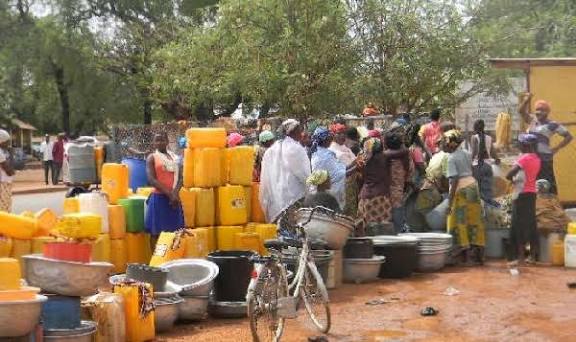

The Ghana Federation of Labour (GFL) has raised alarm over looming water supply challenges, cautioning that persistent shortages could significantly undermine the successful implementation of the government’s proposed 24-hour economy policy.
According to the labour union, reliable access to water remains a critical pillar for industrial productivity, commercial operations and overall economic efficiency — all of which are essential for sustaining round-the-clock economic activity.
Water as a Backbone of a 24-Hour Economy
The GFL stressed that a 24-hour economy cannot thrive without uninterrupted access to basic utilities, particularly water and electricity. The federation noted that industries such as manufacturing, food processing, hospitality, healthcare and sanitation services depend heavily on consistent water supply to operate efficiently.
It warned that irregular water distribution, rationing schedules and infrastructure constraints could disrupt production cycles, increase operational costs and discourage private sector participation in the policy.
“Any attempt to extend working hours without addressing fundamental utility challenges risks placing undue pressure on businesses and workers,” the federation indicated.
Rising Concern Over Infrastructure Gaps
The federation pointed out that many parts of the country continue to face erratic water supply due to aging infrastructure, limited treatment capacity and rapid urban expansion. Without urgent investment in water systems, the ambition to drive economic activity throughout the day and night may encounter serious setbacks.
GFL emphasised that industries operating on continuous shifts require stable water flow for machinery cooling, cleaning processes and compliance with health and safety standards. Disruptions, it noted, could lead to productivity losses and potential job cuts.
Call for Strategic Investment and Coordination
The labour body urged government to prioritise investment in water infrastructure as part of the broader 24-hour economy framework. It called for collaboration between policymakers, utility providers and private sector stakeholders to ensure that foundational services are strengthened before full-scale rollout of the policy.
According to the federation, aligning infrastructure development with economic transformation goals is essential to avoid policy implementation gaps.
Protecting Workers and Businesses
GFL further argued that workers could face additional burdens if businesses are forced to absorb high costs from alternative water sources, such as tanker services and private boreholes. These added expenses, it warned, could be transferred to employees or consumers, weakening the intended economic gains of the policy.
While expressing support for initiatives aimed at boosting productivity and job creation, the federation maintained that sustainable implementation depends on addressing structural challenges first.
The Ghana Federation of Labour concluded that without reliable water supply, the 24-hour economy policy risks falling short of expectations, urging government to treat utility stability as a non-negotiable foundation for national economic transformation.
