
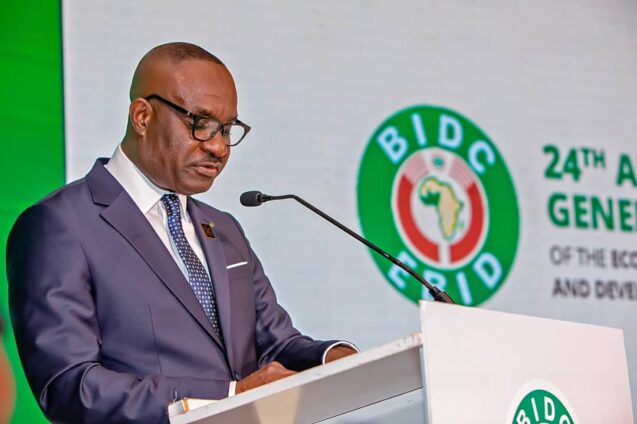

The ECOWAS Bank for Investment and Development (EBID) is set to mobilise approximately $2.69 billion to finance strategic projects across West Africa under its newly unveiled 2026–2030 growth strategy, according to its President, Dr George Agyekum Donkor.
Speaking on the bank’s medium-term vision, Dr Donkor explained that the ambitious financing target forms part of EBID’s broader commitment to accelerating economic transformation and regional integration within the Economic Community of West African States (ECOWAS). He noted that the bank aims to scale up investments in critical sectors such as infrastructure, energy, agriculture, industrialisation, and private sector development.
According to him, the 2026–2030 strategy is designed to address the growing financing gap across the sub-region while supporting member states to build resilient and inclusive economies. He emphasised that the mobilisation of $2.69 billion will be achieved through a mix of internal resources, partnerships with international financial institutions, and innovative financing mechanisms.
Dr Donkor highlighted that EBID will prioritise projects that promote sustainable development, job creation, and economic diversification. He added that the bank intends to strengthen its risk management frameworks and enhance operational efficiency to ensure that investments deliver maximum impact.
The EBID President further stressed the importance of collaboration with governments, development partners, and the private sector to unlock new opportunities and drive long-term growth. He indicated that the bank’s strategy aligns with broader regional and continental development agendas, including efforts to boost intra-African trade and industrial capacity.
The ECOWAS Bank for Investment and Development has in recent years expanded its footprint across West Africa, financing projects in transport, energy, and social infrastructure. The new strategy is expected to consolidate these gains while positioning the institution as a key driver of development finance in the region.
Analysts say the success of the plan will depend largely on effective project execution, strong governance, and the ability to attract co-financing from global partners. Nonetheless, the announcement signals a renewed push by EBID to play a more central role in addressing the development needs of the Economic Community of West African States sub-region.
