
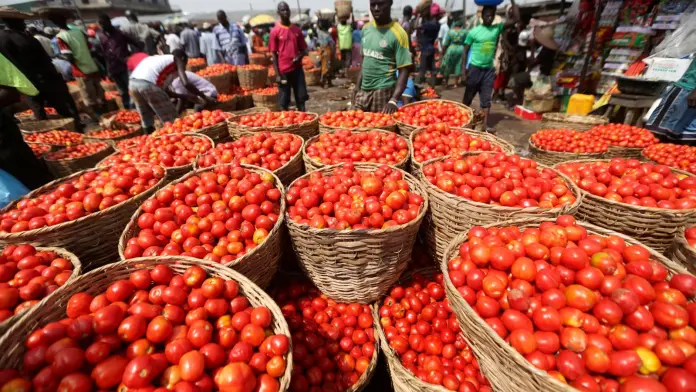

The Governor of the Bank of Ghana has played down concerns over the impact of Burkina Faso’s decision to halt tomato exports to Ghana, urging stakeholders to focus on strengthening local production and value addition in the agricultural sector.
Speaking during an engagement with industry players, the central bank chief noted that while the restriction may cause short-term supply challenges in some markets, it also presents an opportunity for Ghana to invest more in its own tomato value chain. According to him, Ghana has the potential to significantly increase domestic production and reduce reliance on imports if the right policies and investments are put in place.
Burkina Faso, a key supplier of fresh tomatoes to Ghana, recently introduced measures limiting the export of the commodity in an effort to stabilize prices and support local farmers. The development has sparked concerns among traders and consumers, particularly in major urban markets where imported tomatoes play a significant role in meeting demand.
However, Dr. Asiama said the situation should be viewed as a catalyst for long-term transformation rather than a crisis. He stressed that improving storage facilities, expanding irrigation, and promoting agro-processing could help Ghanaian farmers and agribusinesses take advantage of the gap created by the export restrictions.
“The country must look beyond immediate shortages and focus on building a resilient agricultural sector,” he said, adding that value addition — including processing tomatoes into paste and other products — could boost incomes for farmers while reducing post-harvest losses.
He further emphasized that stronger collaboration between financial institutions, government agencies, and private investors would be crucial to achieving these goals. Access to affordable financing, he said, remains a key factor in enabling farmers and agro-processors to scale up operations.
The Governor also encouraged local entrepreneurs to explore opportunities in agribusiness, noting that Ghana’s growing population and urbanization continue to increase demand for food products. Developing a robust local supply chain, he said, would not only address current challenges but also strengthen the country’s food security.
Market analysts say the export ban could temporarily push up tomato prices in some parts of the country. Nonetheless, many agree that increased investment in domestic farming and processing could help stabilize supply over time.
As discussions continue among policymakers and industry stakeholders, the Bank of Ghana maintains that the current development highlights the need for Ghana to accelerate efforts to add value to its agricultural produce and reduce dependence on external sources for key food items.
