
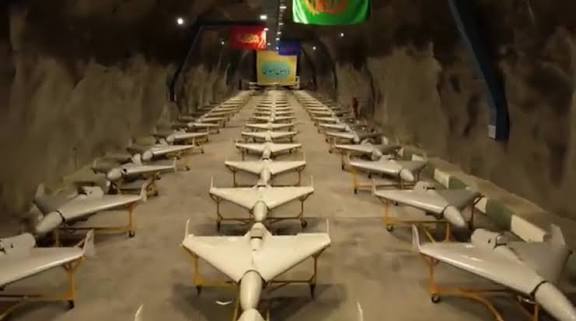

Iran has launched waves of low-cost attack drones across the Middle East in an escalating military campaign that defense experts say is inflicting “exponential costs” on the United States and its allies, potentially prolonging the ongoing conflict.
Military analysts describe Tehran’s strategy as an asymmetric warfare campaign: by deploying cheap, mass-produced unmanned aerial vehicles (UAVs) in large numbers, Iran aims to force expensive Western air defenses to expend costly interceptor missiles and resources in an ongoing battle of attrition.
The bulk of these attacks are being carried out using Iranian-made Shahed-class drones — one-way attack UAVs that cost only tens of thousands of dollars each to produce. In contrast, the U.S. and allied forces use advanced interceptor missiles and air defense systems to counter these threats, with each interceptor costing millions. This imbalance in unit cost creates a steep financial burden for Western militaries, according to defence industry executives and analysts.
“Even a hundred of these drones in the hands of a decentralized unit can cause terror in a neighboring state like never before imagined,” said Cameron Chell, CEO of drone maker Draganfly, in remarks to international media. Chell noted that while Iran cannot win the war solely through drone swarms, the strategy provides Tehran with an asymmetric capability that can extend the conflict and create political pressure on the U.S. and its partners.
The drone campaign intensified amid U.S. and Israeli airstrikes against Iranian military infrastructure, including command centers and missile sites. Iranian drones have targeted U.S. military bases, diplomatic facilities, and allied infrastructure across the region, with several attacks striking sensitive sites in Kuwait, Saudi Arabia, the UAE and Bahrain.
In one reported incident, a drone strike killed six U.S. service members at a tactical operations center in Kuwait — demonstrating that Tehran’s UAVs are not just a financial threat but a lethal one.
Experts emphasise that Iran’s drone strategy is as much economic and psychological as it is military. By flooding the battlefield with inexpensive unmanned systems, Tehran seeks to deplete interceptor inventories, complicate defensive planning and raise the overall cost of the conflict for Washington. Commentators liken the approach to a modern “rope-a-dope,” where Tehran hopes to outlast its adversaries through sheer volume and cost-imposition.
This evolving form of drone warfare underscores broader shifts in modern conflict, where inexpensive unmanned systems can impose disproportionate logistical and economic strains on technologically superior forces. Analysts warn that if such exchanges continue without effective countermeasures, the war could stretch on, exacting a heavy toll on military resources and political will.
