
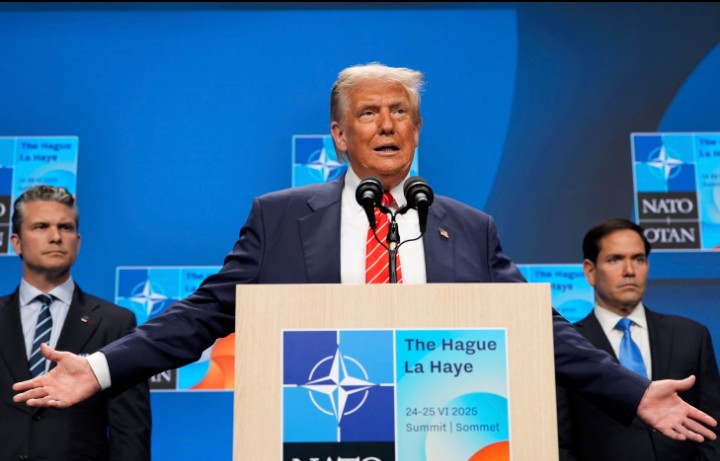

Former U.S. President Donald Trump has intensified pressure on America’s NATO allies to increase their defense commitments, as former Pentagon chief Pete Hegseth sharply criticized what he described as “chronic hesitation” among member states in confronting rising global threats.
Speaking during a high-profile policy forum, Trump reiterated his long-standing position that members of the North Atlantic Treaty Organization must meet their agreed defense spending targets and shoulder a greater share of the alliance’s collective security burden.
“For too long, the United States has carried a disproportionate load,” Trump said. “If we’re serious about deterrence, about strength, and about stability, then every NATO country has to step up — not just in words, but in action.”
The comments come at a time of heightened geopolitical tension, with conflicts in Eastern Europe and the Middle East testing the unity and responsiveness of Western alliances. Trump argued that NATO’s credibility hinges on its willingness to act decisively and collectively in moments of crisis.
Hegseth, who has emerged as a prominent voice in conservative defense circles, echoed Trump’s concerns in even sharper terms. In a separate address, he accused some European governments of “dragging their feet” on military modernization and failing to respond swiftly to shared security challenges.
“Hesitation invites aggression,” Hegseth declared. “When adversaries see division or delay, they exploit it. NATO was built on resolve. That resolve must be visible and unquestionable.”
While several NATO members have increased defense spending in recent years — with more countries meeting the alliance’s benchmark of allocating at least two percent of GDP to defense — disparities remain. Larger economies such as Germany and Italy have faced domestic political constraints in rapidly expanding military budgets, while frontline states in Eastern Europe have pushed for stronger collective commitments.
Officials at NATO headquarters in Brussels responded cautiously, emphasizing the alliance’s unity and ongoing efforts to strengthen deterrence and defense capabilities. “NATO remains the strongest defensive alliance in history,” a spokesperson said, noting recent deployments, joint exercises, and coordinated support initiatives.
Critics, however, argue that Trump’s confrontational rhetoric risks straining transatlantic relations at a delicate moment. Some European leaders have expressed concern that public pressure campaigns could undermine diplomatic cohesion and embolden rival powers seeking to exploit perceived divisions within the alliance.
Supporters of Trump’s approach counter that blunt demands have historically prompted tangible results. During his presidency, Trump frequently warned that the U.S. might reconsider its commitments if allies failed to meet spending goals — a strategy that some analysts credit with accelerating defense investment across Europe.
The renewed debate over NATO burden-sharing underscores broader questions about the future of Western security architecture. As military technology evolves and threats diversify — from cyber warfare to drone strikes and hybrid tactics — alliance members face mounting pressure to modernize their forces and coordinate more closely.
For now, Trump’s remarks and Hegseth’s pointed criticism have reignited a familiar conversation: whether NATO’s strength lies in diplomatic tact and gradual consensus-building, or in forceful demands for immediate action.
With global tensions simmering and elections looming in several member states, the alliance’s cohesion may soon be tested once again — not only by external adversaries, but by internal debates over responsibility, resolve, and the price of collective defense.
